
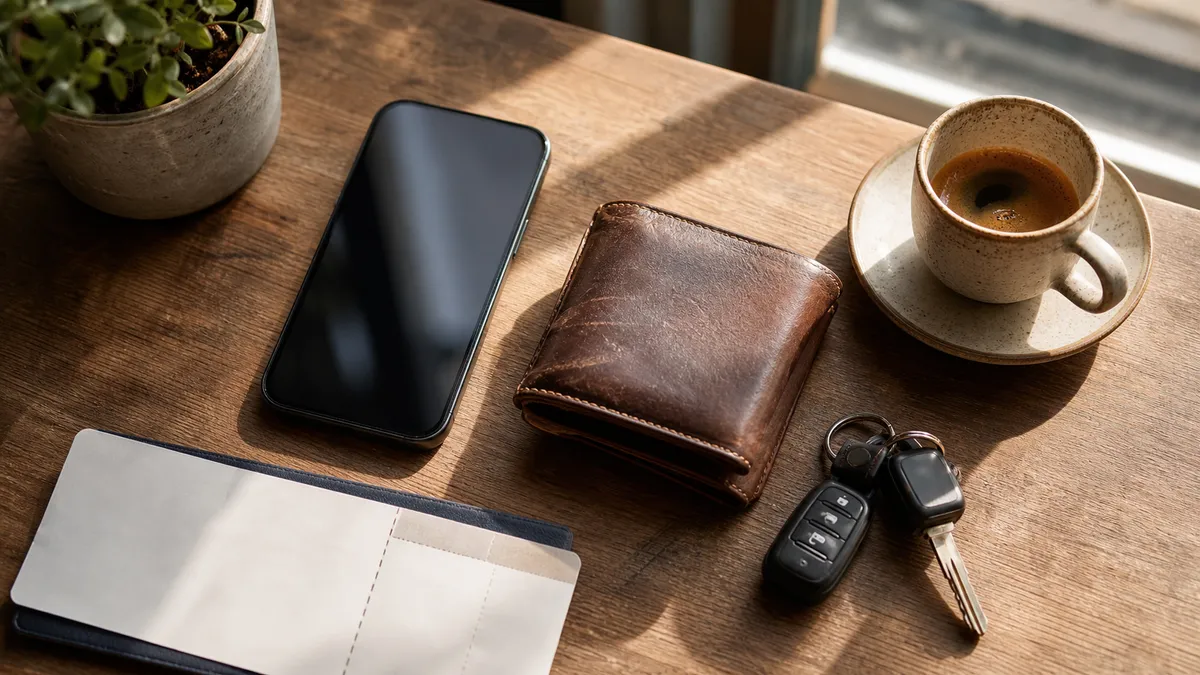
"Digital wallet" has expanded from "payment method" to "container for what matters." Loyalty cards now sit alongside boarding passes, event tickets, and IDs, which is the company you want your brand keeping.
The phrase "digital wallet" used to mean a payment method, a way to pay with your phone instead of a card. That definition is now incomplete. A modern digital wallet is a container for any item that's traditionally lived in a physical wallet: payment cards, loyalty cards, IDs, transit passes, event tickets, boarding passes, prescriptions, vaccination records, and increasingly car keys and house keys.
The major digital wallet platforms in the markets that matter for Shopify merchants:
Apple Wallet. Pre-installed on every iPhone. Supports payment cards, loyalty cards, boarding passes, event tickets, IDs in supported US states, transit cards, and more. Roughly 55% of US smartphone users.
Google Wallet. Pre-installed on Android. Same primitives as Apple Wallet, with the addition of vaccination records and stronger integration with Google Pay. Roughly 45% of US smartphone users globally; higher share in markets like Brazil and India.
Samsung Wallet. Pre-installed on Samsung Galaxy phones. Supports the same primitives as Google Wallet plus car keys for select vehicles. Significant in markets like South Korea and parts of Europe; less critical in the US where Samsung devices use Google Wallet by default.
PayPal Wallet. Cross-platform, app-based. Strong in payment but weaker for non-payment use cases like loyalty cards. Worth supporting if PayPal is a major payment method for your audience but not the primary wallet for loyalty.
For a Shopify merchant in the US, the practical answer is: support Apple Wallet and Google Wallet. Together they cover effectively 100% of the smartphone-using customer base. Samsung Wallet adds value in specific international markets but isn't a US priority.
For the implementation specifics of one platform, our mobile wallet loyalty program guide covers the Apple + Google technical layer in depth. This guide focuses on the strategic layer, how to think about the wallet ecosystem and what it means for your loyalty program.
Open Apple Wallet or Google Wallet on your phone. Count how many items are in it. If your brand isn't there for your most loyal customers, you're missing the surface where customers spend disproportionate attention.
Five wallet capabilities, lock-screen presence, platform trust, no install friction, no storage cost, and POS NFC/barcode, give wallet-based loyalty programs a structural engagement advantage that apps cannot match.
The strategic question for any merchant choosing between a mobile app and a wallet-based loyalty program is what the wallet does that an app can't. The answer is five capabilities, each with measurable business impact.
Apps can technically push notifications to the lock screen, but the system is more aggressive in filtering them, and the customer has to grant explicit notification permissions per app. Wallet pass surfacing is permission-included with the wallet itself, a single permission grant covers all passes in the wallet.
These five capabilities compound. A wallet-based loyalty program has dramatically higher retention, dramatically higher engagement, and dramatically lower friction at the in-store moment. The economic difference is substantial, typically 30-50% higher loyalty-attributed revenue per customer over a 12-month window.
If you currently run a loyalty app, calculate your monthly active rate (active loyalty customers ÷ total enrolled). If it's below 25%, your app is silently failing, and a wallet-based program will outperform it by 4-6x without much work.
Apple Wallet + Google Wallet covers 100% of the US smartphone audience and is the right baseline for any Shopify merchant. Samsung Wallet matters in specific international markets. PayPal Wallet rarely matters for loyalty.
The temptation for resource-constrained merchants is to pick one wallet platform and start there, usually Apple Wallet, since iOS users tend to spend more. The data argues against this approach.
iOS market share in the US is roughly 55%. Android is 45%. If you support only one, you're excluding nearly half your customer base from the loyalty program. The customers who can't use it will either skip the loyalty program entirely or use a less-engaging fallback (email-only loyalty), which means they engage less and churn more.
Most merchants benefit from supporting both Apple Wallet and Google Wallet from day one. The technical effort to support both vs one is marginal, most loyalty platforms that issue Apple Wallet passes also issue Google Wallet passes from the same backend. The visual design has to be done twice (one for each platform's design language), but the data, the update logic, and the integration with your Shopify store work identically.
When Samsung Wallet matters: brands selling significantly in markets where Samsung Galaxy phones dominate. South Korea, parts of Europe, parts of Latin America. Samsung devices in the US default to Google Wallet, supporting Google Wallet automatically covers Samsung users in the US. Don't add Samsung Wallet unless you have specific international market requirements.
When PayPal Wallet matters: rare for loyalty. PayPal's wallet is strongest as a payment method, weaker as a non-payment surface. If you have a customer base that uses PayPal heavily, supporting PayPal payments is more valuable than a PayPal-based loyalty card.
The other emerging wallets. Cash App, Venmo, Chime, are not currently major players in non-payment wallet use. Don't invest engineering effort here unless your specific audience demands it.
The practical recommendation for a Shopify merchant: Apple Wallet + Google Wallet on day one, both designed natively, both updated in real time, both integrated with Shopify POS for in-store identification. This covers your full audience and gives you the wallet capabilities that drive engagement.
For a deeper exploration of the unified online-offline architecture this enables, our omnichannel loyalty program guide covers the full stack.
Before signing with a loyalty platform, ask for live demos of both Apple Wallet and Google Wallet pass issuance. If they show you only one, the integration on the other is likely an afterthought, and your Android customers will get a worse experience.
Wallet pass design is strategic, not visual. Front of pass: brand mark + current status + (optional) next action, under 1 second to read. Back of pass: long-form information. Brand color and microcopy carry as much weight as the layout.
Wallet pass design is usually treated as a visual decision. It's actually a strategic decision about what relationship you're trying to maintain with the customer.
The front of the pass, the surface that appears in the wallet list and on the lock screen, has to communicate three things in under one second: what brand this is, what the customer's current status is, and (if relevant) what action to take next. Anything beyond this is visual noise.
For a transactional loyalty program (earn points, redeem rewards), the front of the pass should show the points balance prominently. The customer's primary question is "how many points do I have?", answer that immediately.
For a tiered program, the front of the pass should show the current tier and progress toward the next. The customer's primary question is "where am I in the system?", show the answer.
For a punch-card-style program (10 stamps for a free coffee), the front of the pass should show the stamps visually. The customer's primary question is "how close am I to the reward?", show it as a progress bar or a stamps grid.
The back of the pass, accessible by tapping the info icon, is for everything else: how the program works, customer service contact, terms and conditions, transaction history (if your platform supports it). This is the long-form information layer.
Brand color is the second strategic decision. The customer recognizes the pass at a glance among the dozens in their wallet. A pass in a generic neutral color is forgettable. A pass in your brand's primary color is recognizable instantly. Use your strongest brand color, not a softened or alternate version.
The logo is the third strategic decision. Most wallet passes default to a small logo in the corner. The strongest passes use the logo as the dominant visual element on the front, with status information overlaid. The brand becomes the primary identifier; the data is secondary.
Microcopy matters more than people expect. "Show this to redeem" is forgettable. "Show your phone, get your latte" is memorable and brand-specific. "Tap for collection drops" works for fashion. "Scan at checkout for points" works for transactional programs. Every word on the pass should sound like your brand wrote it, not the loyalty platform.
For more on how design choices play out across loyalty card formats specifically, our digital punch card guide covers the visual layer in detail.
Mock up your wallet pass on paper first. Show it to three people for 1 second each, then ask what brand it represents and what the customer's current status is. If they can't answer both, simplify until they can.
Wallet notifications must be material to the customer's loyalty status, never promotional. The right cadence is 3-6 notifications per active customer per month. Reward earned, tier upgraded, reward/points expiring, and near-tier-threshold are the high-value triggers.
Wallet pass updates trigger push notifications on the customer's phone. This is the most powerful re-engagement mechanism in the wallet ecosystem, and the easiest to abuse.
The rule: every notification must be material to the customer's loyalty status. Not promotional, not generic, not "check out this week's deals." The wallet platforms enforce this less rigidly than the customer's perception does. A customer who receives a wallet notification that turns out to be a generic marketing message learns to ignore future wallet notifications. The trust gradient is steep, earn it carefully.
The right notification triggers, in order of customer value:
The wrong notification triggers: weekly newsletters, promotional sales (use email), "check out our new collection" (use email), "thanks for being a customer" sentimentality (use email). These erode wallet trust without material customer value.
The right cadence: 3-6 wallet notifications per active customer per month. Below 2, the customer forgets they have the pass. Above 8, you risk notification fatigue and wallet deletion. The sweet spot is enough to maintain relevance without exhausting attention.
For more on how wallet notifications compare with other engagement channels, our push vs email ROI calculator shows the math.
List every notification trigger your loyalty platform supports. For each one, ask: does this notification tell the customer something material about their account? If no, turn it off. The trust gained is worth more than the marketing reach lost.
The wallet pass is the primary identity layer. Email is marketing. SMS is urgency. Website is deep information. Physical signage is in-store awareness. The wallet pass is what the customer sees daily, the other channels are intermittent moments.
A digital wallet loyalty program is a channel, not a replacement for your other channels. Email still matters. SMS still matters. Your website still matters. The strategic question is what role the wallet plays alongside them.
The wallet pass is the primary identity layer. It identifies the customer in-store via NFC or barcode. It carries their loyalty status everywhere they go on their phone. It surfaces on the lock screen when relevant. The wallet is the customer's loyalty card, the singular artifact that represents the relationship.
The website is the deep-information layer. Customers visit the site to learn how the program works, see the rewards catalog, redeem complex rewards, manage account settings. The site does the heavy lifting; the wallet pass surfaces the highlights.
The meta-pattern: the wallet pass is the always-on identity. The other channels are intermittent contact moments. The wallet is what the customer sees most days; the other channels are what the customer sees on specific days.
This positioning has implications for staffing and resource allocation. The wallet pass needs ongoing design attention (seasonal updates, tier-specific designs) but very little ongoing operational work. Email and SMS need ongoing campaign work. Plan accordingly, the wallet is a fixed-cost investment with declining marginal cost; email and SMS are variable-cost channels that scale with send volume.
Map your current loyalty program's channel mix. If you're using email for everything (status updates, urgency, deep information, identity), you're missing the wallet pass's structural advantage as the always-on identity layer.

Digital wallet loyalty plays a different strategic role per industry: operational layer for quick-service, status layer for fashion, discovery bridge for beauty, long-cycle relationship for home, recurring-purchase reminder for wellness, and relationship status for B2B. Match the design to the role.
The strategic role of a digital wallet loyalty program varies meaningfully by industry. The pattern that works for coffee doesn't work for furniture, and vice versa.
Health and wellness (supplements, athletic wear, fitness products). The wallet pass is the recurring-purchase reminder. Customers buy regularly but on different cadences. The pass updates when the customer is approaching their next subscription order or has a reward eligibility change. Notifications work as gentle nudges rather than urgent calls.
The meta-pattern: identify the single most important thing your industry's customers want to know at-a-glance about their relationship with your brand. Build the wallet pass around that one piece of information.
Interview five of your highest-LTV customers. Ask: "If you had a wallet pass for our brand on your phone, what's the single piece of information you'd want to see first?" Their answer is your wallet pass design brief.
Six wallet-specific metrics matter: add-to-wallet rate, pass retention, update-to-engagement, in-store identification, location-trigger conversion, and wallet-attributed revenue. Track these monthly to see what your standard loyalty KPIs hide.
Generic loyalty metrics don't capture what's working in a digital wallet program. Six wallet-specific metrics tell the real story.
Use our loyalty ROI calculator to model the impact of moving from a 25% wallet-installed loyalty base to 60%+ wallet-installed. The lift in repeat purchase rate is typically 30-50% over 12 months, the wallet pass isn't a feature, it's a structural lever.
Build a monthly dashboard that tracks these six wallet-specific metrics alongside standard loyalty KPIs (enrollment, repeat purchase rate, redemption rate). The wallet metrics are the leading indicators, they move first when something is working or breaking.
If you're not currently tracking add-to-wallet rate, start there. Estimate it from your last 90 days of data: customers who saw a wallet prompt ÷ customers who added a pass. The number will surprise you, usually higher than expected, with room to grow with prompt optimization.
Five strategic mistakes account for most underperforming digital wallet loyalty programs: treating the wallet as a feature, supporting only one platform, overusing notifications, skipping staff training, and skipping soft launch. Each is preventable with deliberate planning.
After watching hundreds of digital wallet loyalty programs launch on Shopify, the same five strategic mistakes account for most underperforming setups.
Mistake one: treating the wallet pass as a feature instead of a channel. Brands add wallet pass support to their existing loyalty program and call it done. The result is a wallet pass that exists but doesn't change customer behavior. A wallet-first program is structurally different, the pass is the primary identity layer, the in-store NFC tap is the primary identification method, the wallet notifications are the primary engagement channel. If you bolt the wallet onto an app-first or email-first program, you get wallet pass installations without the engagement lift.
The meta-mistake: treating digital wallet loyalty as a tactical implementation rather than a strategic shift. The wallet pass changes how the loyalty program reaches customers. That's a strategic decision that should be made at the leadership level, not a checkbox handed to whoever owns the loyalty platform configuration.
For the operational rollout details, our customer retention strategies guide covers the broader retention context that wallet loyalty fits into.
Audit your current loyalty program against these five. If you score "yes" on more than two, you have meaningful upside before any platform or technology change, the strategic decisions are the highest leverage.
Digital wallets have evolved from "a way to pay" to "the container for what matters." Loyalty cards belong in that container, alongside boarding passes, event tickets, and IDs. A digital wallet loyalty program treats the wallet as the primary delivery layer, not a feature bolted onto a traditional loyalty system. The strategic decisions matter as much as the technology: which platforms to support (Apple + Google for full coverage), how to design the pass (front-of-pass clarity in under 1 second), how often to update (3-6 notifications per active customer per month, all material), and where the wallet sits in your channel mix (primary identity layer, with email handling marketing and SMS handling urgency). The merchants who treat this as a strategic shift, not a checkbox, see 30-50% lift in loyalty-attributed revenue within a year.
Pick a loyalty platform that issues both Apple Wallet and Google Wallet passes natively, integrates with Shopify POS for in-store identification, and treats the wallet pass as the primary engagement channel, not an afterthought. The strategic upside is meaningful, and the rollout is realistic in 14 days.
JeriCommerce issues both Apple Wallet and Google Wallet passes from one Shopify install. Real-time updates, NFC tap at POS, location-based lock-screen presence. Free plan available.
Install Free on Shopify